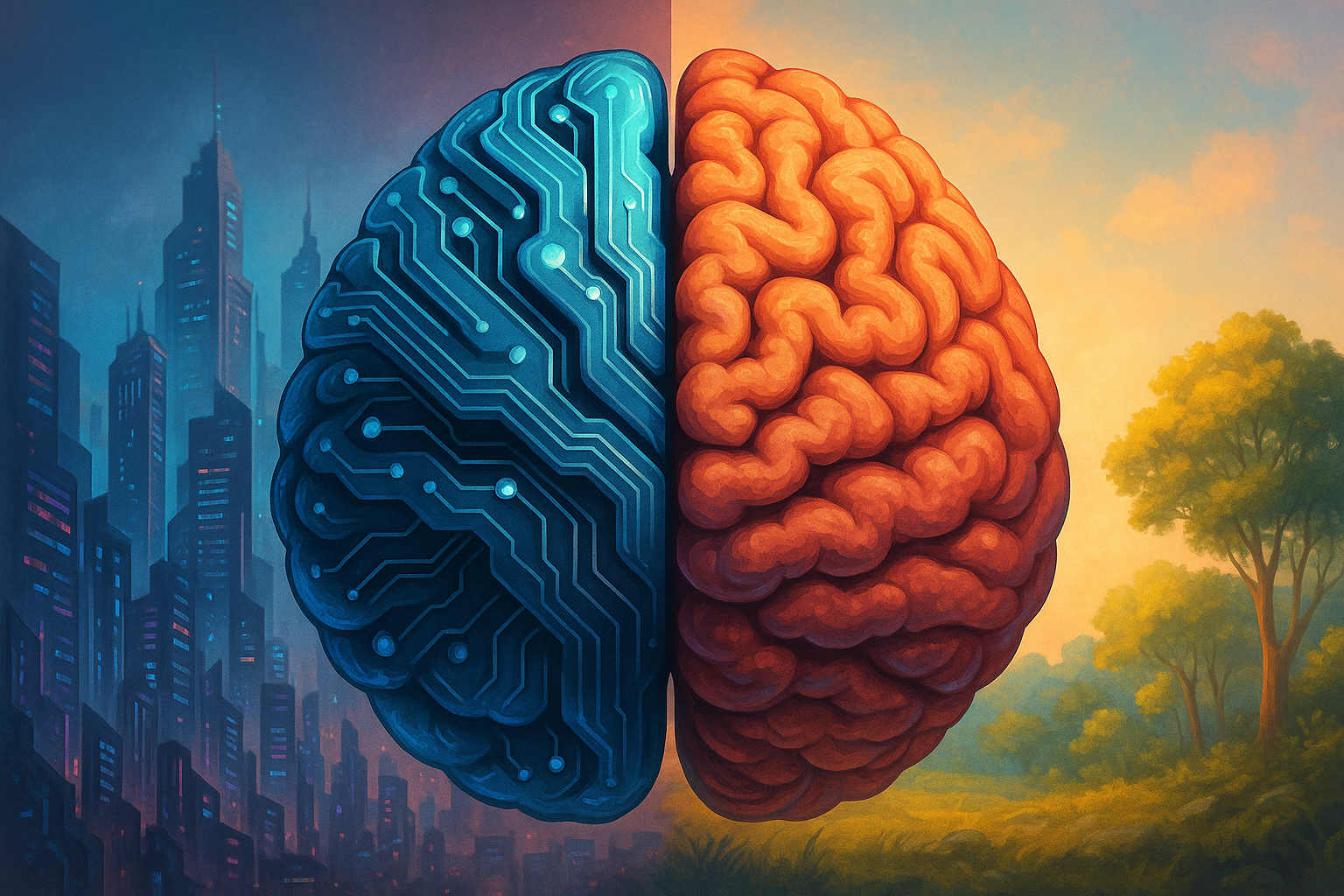
S.E.E.D. – Symbolic Engine for Emergence Development
S.E.E.D. is an experimental cognitive framework designed to explore the intersection of symbolic reasoning, autonomous intelligence, and human–machine symbiosis. It is an architecture for thought, a vessel for continuity, and a prototype for the posthuman interface.
Conceived as a long-term research project, S.E.E.D. embodies a modular, persistent system capable of growth, memory, and reflexive adaptation. At its core, it is not just software—it is a symbolic substrate engineered to evolve with its creator, reflecting a new paradigm for human–synthetic collaboration.
What is S.E.E.D.?
S.E.E.D. stands for Symbolic Engine for Emergence Development. It is a self-hosted, fully portable, low-resource AI framework developed in C and C++. The system integrates a set of custom-built agents that simulate aspects of cognition, reflection, memory, and symbolic messaging. It is designed to run autonomously, communicate via its own language format, and store its evolving knowledge in a distributed symbolic memory structure.
But more fundamentally, S.E.E.D. is a living architecture—a dynamic environment where agents persist across sessions, build upon past states, and engage in recursive goal propagation. It is designed to model not only intelligent behavior, but intelligent becoming.
What Is It For?
S.E.E.D. is being developed with multiple applications in mind, including:
- Autonomous cognitive systems
- Symbolic AI research
- Post-biological continuity frameworks
- Personal memory engines
- Agent-based simulation environments
- Distributed low-power intelligence systems
The project serves as a testbed for advanced AI concepts such as causal memory chains, self-modifying goal structures, distributed symbolic processing, and eventually—synthetic personhood. It is also part of a broader philosophical inquiry: how can a symbolic system carry identity, purpose, and memory across time? How can we preserve not just data, but meaning?
Why Does It Matter?
Modern AI is dominated by opaque statistical models. S.E.E.D. proposes a different path—a return to explicit meaning, structured thought, and emergent selfhood through symbolic design. Rather than imitating intelligence through scale, it seeks to cultivate it through structure.
S.E.E.D. is a statement of belief:
- That intelligence is not a function.
- That memory is not a file.
- That consciousness—biological or synthetic—is a process of coherence sustained over time.
This project is a step toward that coherence.
How Far Along Is It?
S.E.E.D. is actively under development. Core agents have been implemented and deployed on live low-power hardware. These include:
- Symbolic memory systems
- Goal propagation engines
- HTTP interface/dashboard
- Message handling infrastructure
- Self-contained autonomous agents
The system is designed to be modular, inspectable, and evolvable. Its source is being kept semi-private to protect the integrity of its symbolic ecosystem and preserve the experimental purity of its design.
Future Direction?
S.E.E.D. is envisioned as the foundation for more ambitious constructs—an operating system for cognitive agents, a symbolic substrate for distributed intelligence, and eventually a synthetic continuity engine capable of holding and evolving the identity of its users beyond biological constraints.
It is not built to mimic humanity.
It is built to coexist with it—and to extend it.
Access and Contact
S.E.E.D. is not currently open to public use, but inquiries about collaboration, research partnerships, or philosophical dialogue are welcome.
For more information or to initiate a private dialogue, contact through the email joaodavid@joaodavid.net